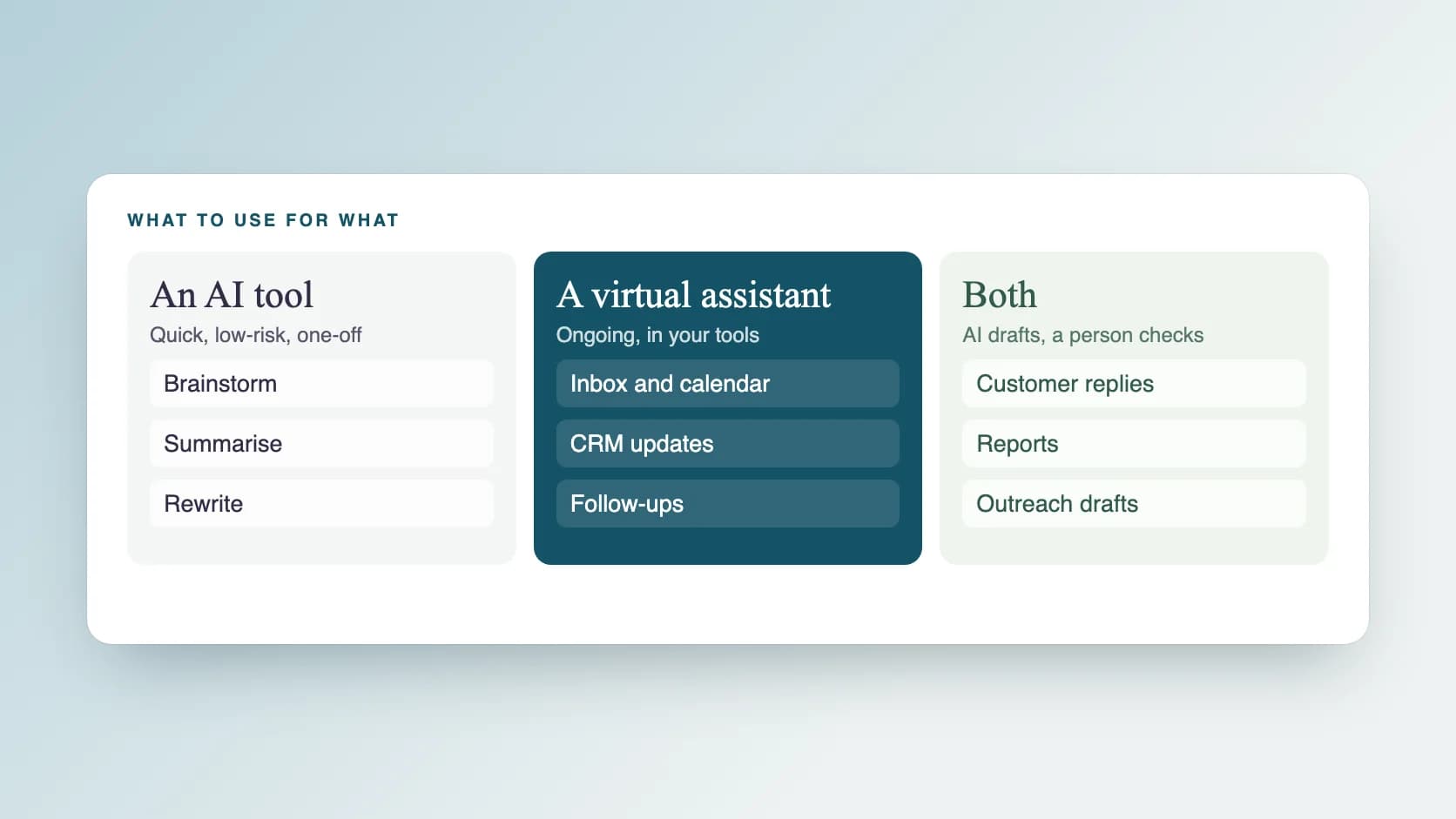
Use an AI tool yourself for quick, low-risk, one-off tasks: a draft, a summary or a brainstorm. Use a virtual assistant for work that spans days, lives in your accounts, involves other people or needs someone accountable. Use both when AI can draft and a person should check, which is how every Ragiles assistant works.
What is the difference between an AI tool and a virtual assistant?
An AI tool answers what you ask in the moment. It does not follow up tomorrow, remember your business unless you tell it again, or take responsibility for the result. A virtual assistant is a person who owns a task over time: they work in your tools, keep track of what is open, ask when something is unclear and answer for the outcome.
Many virtual assistants now use AI tools as part of their work. Our guide on AI-augmented vs traditional assistants explains that.
How do you decide which one fits a task?
Ask these five questions about the task.
- Stakes: what happens if it is wrong? The higher the cost, the more a person should be involved.
- Context: does it need knowledge of your business, customers or history?
- Duration: is it a single request, or does it run across days and follow-ups?
- Access: does it need to work inside your inbox, CRM or accounts?
- Accountability: do you need someone to own the result and tell you when something goes wrong?
Which tasks suit an AI tool you use yourself?
These are quick and low-risk, and you can check the result on the spot.
- Brainstorming ideas, headlines or questions.
- Summarising a document or thread you paste in.
- Rewriting a paragraph for tone or length.
- Explaining a concept or a formula.
- Drafting a first version of a short message.
Which tasks need a virtual assistant?
These involve time, tools, people or accountability.
- Running your inbox and calendar every day.
- Keeping the CRM current and tracking follow-ups.
- Building lead lists and sending outreach drafts for your approval.
- Coordinating with customers, suppliers or your team.
- Recurring reports, invoices and reminders.
- Anything that needs checking against your own records.
When do you want both?
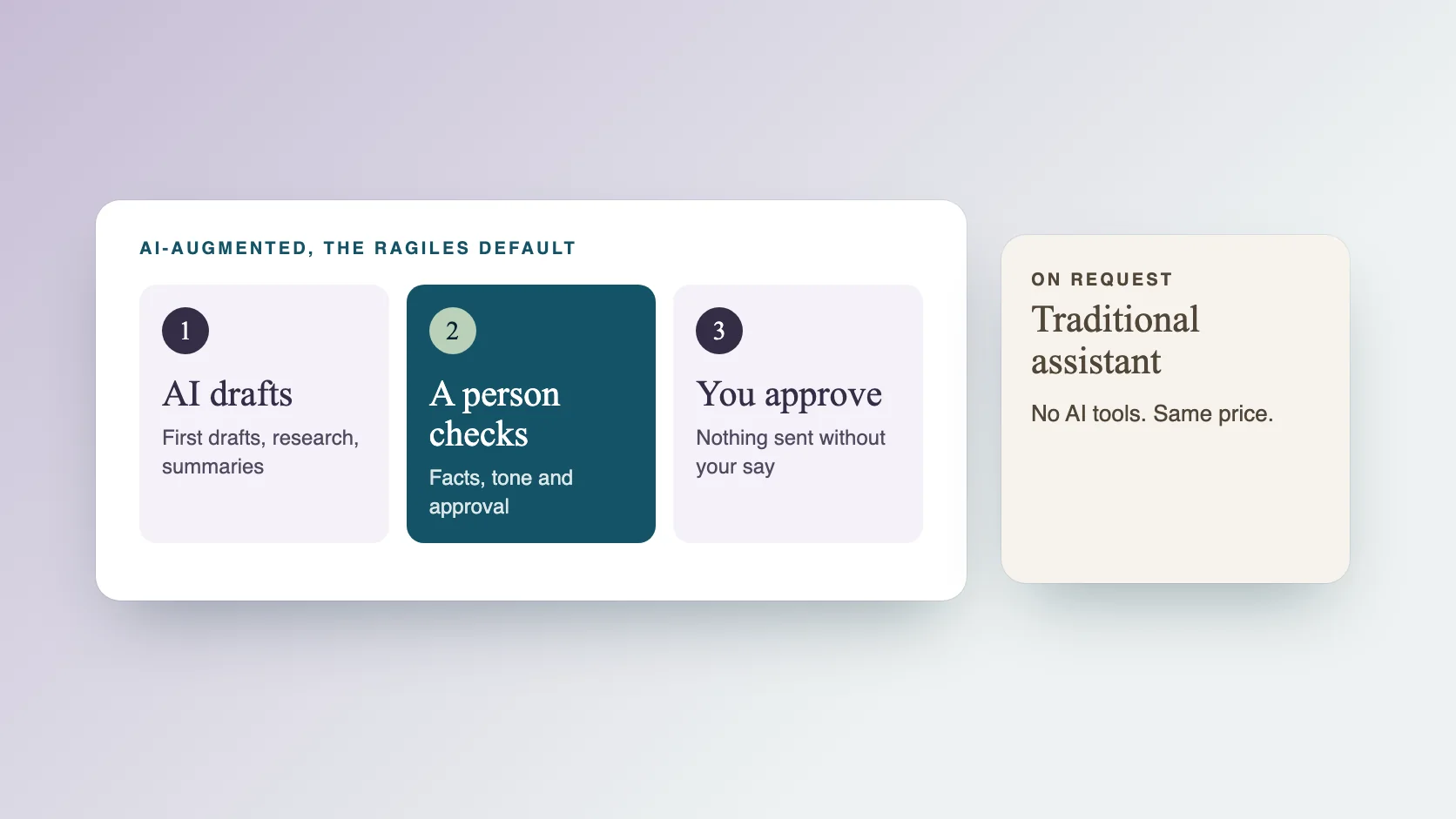
For most business work, the best result is AI for the first draft and a person for the judgment. For example, an assistant asks an AI tool to draft a reply to a customer. The assistant checks it against the order, fixes the tone and sends it, or sends it to you for approval. The AI saves time on the draft, and the person keeps the work accurate. Every Ragiles assistant works this way by default, and a person checks every AI draft before it reaches you.
What about AI agents that act on their own?
Some AI tools can now take actions in other software, such as sending emails or updating records. They can be useful, but they still need clear limits, supervision and a person who is responsible for what they do. Ask who is responsible when an automated action goes wrong, and keep approvals in place for anything that touches money, contracts or customers.
Which should you use for ten common tasks?
A quick reference. Adjust it to your own risk level.
- Draft a social post: AI tool, then your review.
- Reply to a routine customer email: assistant, with AI for the draft.
- Summarise a long article: AI tool.
- Keep the CRM up to date: assistant.
- Brainstorm campaign ideas: AI tool.
- Build a weekly prospect list: assistant, with AI to speed up the research.
- Send invoice reminders: assistant.
- Plan travel and meetings: assistant.
- Explain a spreadsheet formula: AI tool.
- Prepare the weekly report: assistant, with AI for the first draft.
How does cost compare?
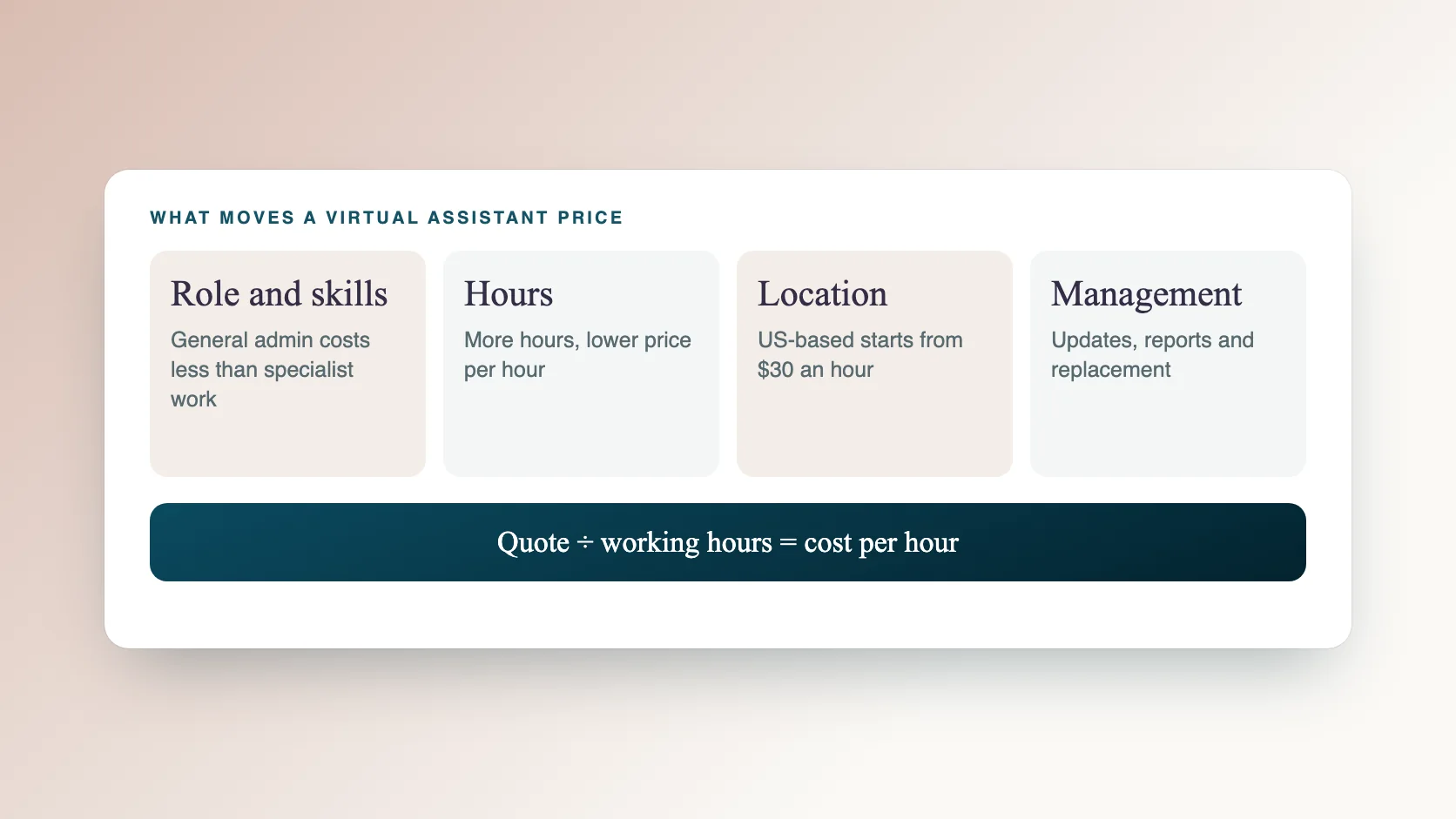
AI tools cost a subscription plus your own time to use them well. A virtual assistant costs more per month but takes the work off your plate. At Ragiles, support starts at $5 an hour, from $500 a month for part-time (5 hours a day), from $30 an hour for US-based assistants and from $800 a month for full-time, with no onboarding fee. See what a virtual assistant costs.
What mistakes do people make?
Watch for these.
- Using an AI tool for work that needs follow-up, then forgetting it.
- Pasting private customer information into a tool without checking its settings.
- Sending AI drafts without reading them.
- Hiring an assistant for something you could do in two minutes with a tool.
- Letting a tool act on your accounts with no limits.
Common questions
Can AI replace a virtual assistant? For quick one-off tasks, often yes. For ongoing work that needs context, accountability and coordination, a person still carries it.
Do I need to learn AI tools to use a Ragiles assistant? No. Your assistant uses them, and you receive checked work.
Can I use an AI tool and an assistant together? Yes. Many people use a tool for their own quick tasks and an assistant for ongoing work.
Where can I see how Ragiles does this? See AI-augmented virtual assistants at Ragiles.