

Everything You Need to Know About Virtual Assistants
How founders, executives, and small businesses use Virtual Assistants to save time, scale faster, and work smarter
Why Virtual Assistants Are No Longer Optional
You wake up to a full inbox. Your calendar is packed. Small tasks pile up while strategic work keeps getting pushed to “tomorrow.” If you run a business, lead a team, or manage multiple responsibilities, this scenario probably feels familiar.
Today’s business environment moves fast. You face constant pressure to do more with less, less time, fewer resources, and tighter margins. That is exactly why Virtual Assistants are no longer a luxury; they are a necessity.
A Virtual Assistant helps you reclaim your time so you can focus on what actually grows your business. Instead of spending hours on emails, scheduling, follow-ups, data entry, or operational details, you delegate those tasks to a trained professional who works remotely but integrates seamlessly into your workflow.
What makes Virtual Assistants especially powerful today is how much their role has evolved. In the past, you may have thought of a VA as basic admin support.
Now, Virtual Assistants function as strategic partners, personal assistants, and even virtual executives who support founders and leadership teams at a high level.
Across the United States, United Kingdom, Australia, Canada, New Zealand, India, and the Middle East, businesses of all sizes actively adopt virtual support models.
Startups use Virtual Assistants to stay lean. Small businesses rely on them to scale operations without increasing overhead. Executives depend on them to protect focus and decision-making time.
If you want to:
- Access global talent without geographic limits
- Work on your business instead of in it
- Reduce burnout without sacrificing performance
- Scale efficiently without hiring full-time staff
Then understanding how Virtual Assistants work, and how to use them effectively, becomes essential.
In this guide, you learn everything you need to know about Virtual Assistants: what they do, how they differ from personal assistants, how businesses use them successfully, and how you can decide if hiring one makes sense for you.
You also see how Virtual Assistant agencies help businesses avoid common mistakes and scale with confidence.
This is how modern businesses operate today.
What Is a Virtual Assistant? (And What They Are Not)
A Virtual Assistant (VA) is a skilled professional who supports your business remotely by handling tasks that consume your time but do not require your constant attention.
You work with them online, communicate through digital tools, and integrate them into your daily operations just like an in-house team member.
At its core, a Virtual Assistant exists to help you work smarter, not longer.
You delegate tasks. They execute with precision. You stay focused on growth, leadership, and decision-making.
What a Virtual Assistant Is
A Virtual Assistant is:
- A trained professional with defined skills
- A reliable extension of your team
- A long-term productivity partner
- A role-based solution, not just task-based help
Depending on your needs, your VA may manage administrative work, customer communication, marketing operations, executive scheduling, research, reporting, or process coordination.
Many Virtual Assistants specialize in specific functions and industries, which means you gain expertise, not just availability.
Most importantly, a Virtual Assistant works proactively, not reactively. The right VA anticipates needs, follows systems, and improves efficiency over time.
What a Virtual Assistant Is Not
Understanding what a Virtual Assistant is not helps you avoid mismatched expectations.
A Virtual Assistant is not:
- A temporary freelancer with no accountability
- A low-cost replacement for strategic thinking
- Someone you micromanage task by task
- An untrained generalist who “figures it out”
If you treat a VA like disposable labor, you miss their real value. Virtual Assistants perform best when you give them clear outcomes, repeatable processes, and ownership over responsibilities.
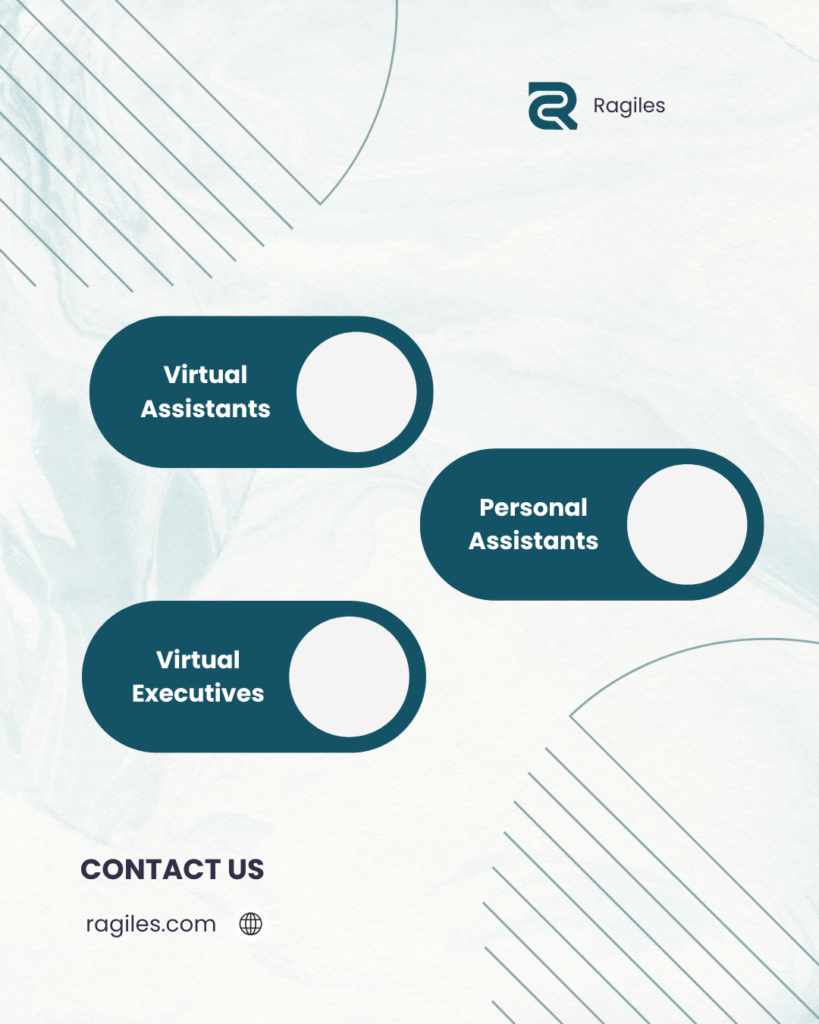
Virtual Assistants vs Personal Assistants vs Virtual Executives
- Focus on operational and functional tasks
- Support day-to-day execution
- Ideal for small businesses and growing teams
- Focus on individual productivity
- Manage schedules, reminders, coordination, and personal logistics
- Often work closely with founders or executives
Virtual Executives (or Executive Virtual Assistants)
- Operate at a leadership support level
- Manage priorities, workflows, reporting, and decision preparation
- Act as a strategic right hand for founders and senior executives
As your business grows, your needs evolve. Many founders start with an administrative Virtual Assistant and later upgrade to a personal or executive-level virtual role.
Why “Virtual” Does Not Mean Less Effective
One of the biggest misconceptions you may have is that remote support equals lower quality. In reality, the opposite often proves true.
Virtual Assistants:
- Work in focused environments
- Use documented processes
- Operate with performance metrics
- Deliver results without office distractions
Because VAs work remotely, you also access a global talent pool. You hire based on skill, experience, and reliability, not location. This is why businesses across the US, UK, Australia, and the Middle East actively rely on Virtual Assistants to stay competitive.
When you understand what a Virtual Assistant truly is, and what they are not, you set the foundation for a successful working relationship.
The Rise of Virtual Assistants in Global Business

You are not imagining it, Virtual Assistants are everywhere right now. What once feels like a niche outsourcing option has become a mainstream business strategy across industries and regions.
This shift does not happen by accident. It happens because the way you work has fundamentally changed.
Remote Work Becomes the New Normal

Remote work no longer feels experimental. You already collaborate through email, Slack, Zoom, project management tools, and cloud platforms. A Virtual Assistant fits naturally into this ecosystem.
Instead of hiring someone locally and forcing work into a physical office, you build a location-independent team. Your business operates faster, leaner, and with fewer constraints.
Virtual Assistants thrive in this model because their work is already designed for remote execution. You gain productivity without adding operational complexity.
Cost Pressure Forces Smarter Hiring Decisions
If you run a small or mid-sized business, you constantly balance growth with expenses. Hiring full-time, in-house employees adds long-term financial commitments, salaries, benefits, office space, equipment, and compliance costs.
A Virtual Assistant changes the equation.
You pay for:
- Skills instead of overhead
- Output instead of idle time
- Flexibility instead of fixed commitments
This is why businesses in the United States, United Kingdom, Australia, Canada, New Zealand, India, and the Middle East increasingly replace or supplement traditional roles with Virtual Assistants. You scale support up or down without restructuring your entire organization.
Access to Global Talent Gives You an Edge
When you limit hiring to your local market, you limit your options. With Virtual Assistants, you tap into a global talent pool that brings diverse experience, strong work ethics, and specialized skills.
You no longer ask:
“Who can I hire near me?”
Instead, you ask:
“Who is the best person for this role?”
This shift alone transforms how efficiently you build teams.
Businesses Need Speed, Not Just Support
Markets move fast. Opportunities appear and disappear quickly. When your internal workload slows you down, you lose momentum.
Virtual Assistants help you:
- Execute faster
- Respond to customers quicker
- Maintain consistency as demand increases
- Free leadership time for strategy and growth
Founders and executives do not hire Virtual Assistants because they want help. They hire them because they want speed, focus, and leverage.
Types of Virtual Assistants You Can Hire
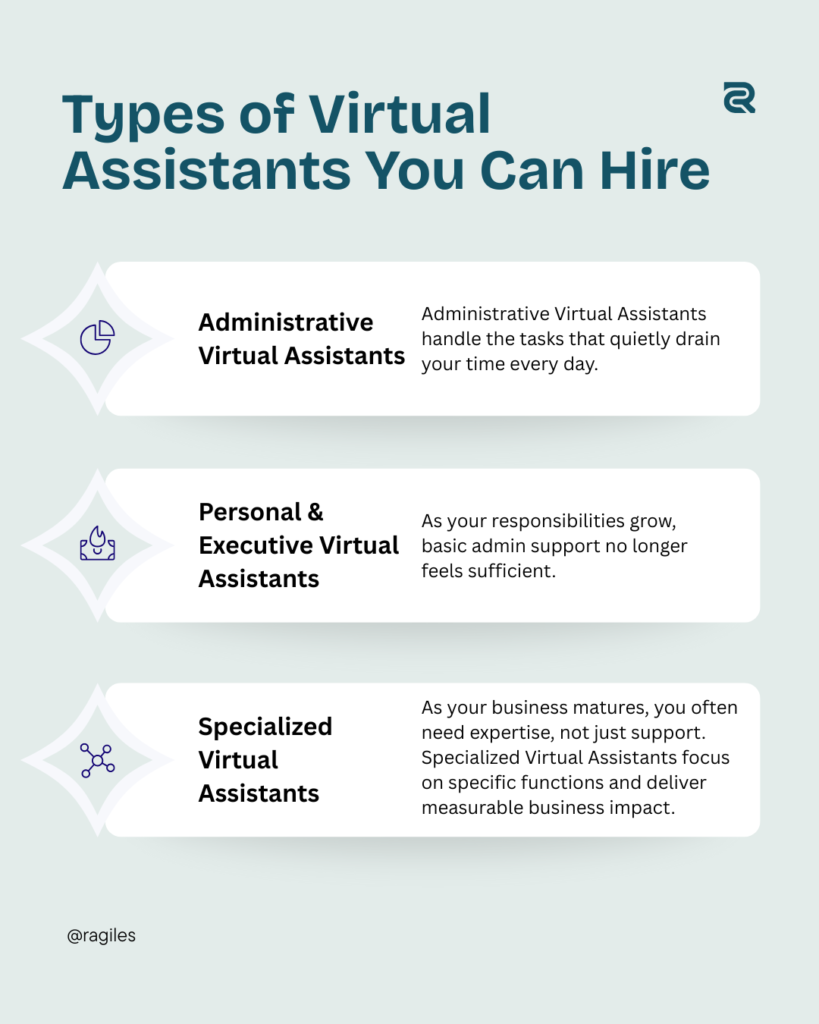
Not all Virtual Assistants do the same work, and that is a good thing. When you understand the different types of Virtual Assistants available, you stop hiring “general help” and start building role-based support that actually moves your business forward.
You do not hire virtual assistants (VAs) to do everything. You hire the right virtual assistants (VAs) to do the right things.
A. Administrative Virtual Assistants
Administrative Virtual Assistants handle the tasks that quietly drain your time every day. These tasks may seem small, but together they consume hours of your week.
You typically use an administrative VA to manage:
- Email inbox organization and responses
- Calendar scheduling and meeting coordination
- Data entry and document management
- File organization and CRM updates
- Travel planning and expense tracking
If you feel busy but not productive, this is often where you start. Administrative Virtual Assistants give you immediate relief and restore control over your schedule.
B. Personal & Executive Virtual Assistants
As your responsibilities grow, basic admin support no longer feels sufficient. Then you need Personal Assistants and Executive Virtual Assistants.
A Personal or Executive VA works closely with you, not just your task list.
They help you:
- Prioritize your day and protect focus time
- Manage executive calendars and deadlines
- Coordinate with internal teams and external partners
- Prepare briefs, reports, and summaries
- Track follow-ups and commitments
At this level, your virtual assistants (VAs) understand your preferences, decision-making style, and business rhythm. You stop reacting to work and start operating intentionally.
This is especially valuable for founders, executives, and leaders managing multiple projects or companies.
C. Specialized Virtual Assistants
As your business matures, you often need expertise, not just support. Specialized Virtual Assistants focus on specific functions and deliver measurable business impact.
Common specialized VA roles include:
Email marketing support
- Social media management
- Content scheduling and coordination
- Email marketing support
- SEO research and reporting
Sales & CRM Virtual Assistants
- Lead Generation
- Go To Market (GTM) and BDR
- Lead management and qualification
- CRM updates and pipeline tracking
- Follow-ups and outreach coordination
- Sales reporting
Customer Support Virtual Assistants
- Live chat and email support
- Ticket management
- Customer onboarding assistance
- Feedback collection
Finance & Bookkeeping Virtual Assistants
- Invoicing and payment tracking
- Expense categorization
- Financial reporting support
- Payroll coordination
Technical & Automation Virtual Assistants
- Tool integrations
- Workflow automation
- No-code platform management
- System documentation
Choosing the Right Type for Your Business
The biggest mistake you can make is hiring too broadly. The smartest approach is to:
- Identify tasks you repeatedly delay or avoid
- Group them by function
- Match them to the appropriate VA role
You start small. You expand strategically. Over time, your Virtual Assistants become a structured support system, not a patchwork solution.
Virtual Assistants vs In-House Employees
At some point, you face a critical decision:
Do you hire in-house, or do you delegate to a Virtual Assistant?
This choice shapes your costs, flexibility, and long-term scalability. When you compare both options side by side, the differences become clear.
Cost: Fixed Overhead vs Flexible Investment
Hiring an in-house employee means committing to:
- A full-time salary
- Benefits and insurance
- Office space and equipment
- Paid leave and downtime
- Compliance and HR overhead
A Virtual Assistant removes most of these costs.
With a VA, you invest in:
- Skills and execution
- Defined working hours
- Measurable output
- Scalable support
You pay for value delivered, not for presence.
Flexibility: Scale Up or Down Without Risk
Business demand rarely stays constant. Some months feel intense. Others slow down.
In-house teams struggle with this reality. You either overload employees or carry unnecessary costs.
Virtual Assistants give you flexibility:
- Increase hours during peak periods
- Reduce scope when priorities shift
- Add specialized roles without restructuring
- Adapt quickly without long-term risk
This agility helps small businesses and founders stay resilient.
Speed: Weeks vs Days
Hiring in-house takes time:
- Job postings
- Interviews
- Notice periods
- Onboarding delays
With Virtual Assistants, especially through an agency, you move faster. You often onboard trained professionals in days, not weeks.
Speed matters when opportunities appear and workloads spike unexpectedly.
Commitment: Long-Term Employment vs Outcome-Based Support
In-house hiring creates long-term commitments. That works well for core roles that require deep internal alignment.
Virtual Assistants work best when:
- Tasks are repeatable
- Processes are documented
- Outcomes are clear
You maintain control without overcommitting. If needs change, you adjust without disruption.
When In-House Still Makes Sense
Virtual Assistants are powerful, but they are not a replacement for every role.
In-house employees make sense when:
- The role requires constant in-person presence
- Deep internal decision authority is needed
- The position defines company culture and leadership
Many businesses succeed with a hybrid model: a lean in-house team supported by Virtual Assistants who handle execution and operations.
The Smarter Question to Ask
Instead of asking:
“Should I hire a Virtual Assistant or an employee?”
Ask:
“Which tasks truly require a full-time, in-house role, and which do not?”
Once you answer that honestly, the right decision becomes obvious.
Benefits of Hiring a Virtual Assistant

When you hire a Virtual Assistant, you do not just offload tasks, you change how you operate.
The benefits go far beyond convenience. They impact your time, energy, decision-making, and long-term growth.
You Reclaim Time for What Actually Matters
Your time is your most valuable asset. Yet, much of it disappears into low-impact work.
A Virtual Assistant gives you time back by handling:
- Routine operations
- Administrative follow-ups
- Repetitive coordination tasks
With those off your plate, you focus on leadership, strategy, clients, and growth. You stop feeling busy and start feeling effective.
You Reduce Burnout and Decision Fatigue
Constant small decisions drain mental energy. When your day fills with interruptions, you lose clarity and momentum.
Your VA helps you:
- Structure your day
- Filter noise from priorities
- Keep systems running smoothly
As a result, you make better decisions and maintain consistency without exhaustion.
You Lower Costs Without Lowering Quality
Hiring full-time staff increases fixed costs. Virtual Assistants keep expenses lean while maintaining high standards.
You benefit from:
- No office overhead
- No long-term employment risk
- Access to skilled professionals
- Pay-for-performance models
This is especially valuable for small businesses and growing teams that need efficiency without compromise.
You Gain Global Coverage and Continuity
Virtual Assistants often work across time zones. This allows your business to move forward even when you are offline.
You gain:
- Faster customer response times
- Extended operational hours
- Consistent task execution
For businesses operating in the US, UK, Australia, Canada, and the Middle East, this creates a competitive advantage without expanding internal shifts.
You Execute Faster and Scale Smarter
Growth creates complexity. Without support, execution slows down.
Virtual Assistants help you:
- Maintain operational consistency
- Launch initiatives faster
- Scale processes without chaos
You build momentum without overloading yourself or your core team.
The Real Benefit: Leverage
The biggest advantage of a Virtual Assistant is leverage.
You stop trading time for output. Instead, you multiply your effectiveness through delegation, systems, and support.
That is how modern founders and executives stay focused, agile, and ahead.
Challenges & Common Mistakes When Hiring Virtual Assistants

Virtual Assistants deliver incredible value,but only when you set them up for success.
Most problems you hear about VAs do not come from the model itself. They come from how you hire, onboard, and manage the relationship.
When you understand the common pitfalls, you avoid frustration and get results faster.
Mistake #1: Skipping Proper Onboarding
You cannot expect results if you do not invest in onboarding.
Many business owners hire a VA and immediately start delegating tasks with little context. This leads to confusion, rework, and missed expectations.
To avoid this:
- Share clear goals and priorities
- Explain how your business operates
- Provide access to tools and documentation
- Define what success looks like
A strong onboarding phase saves you weeks of corrections later.
Mistake #2: Hiring Without Long-Term Intent
Hiring a Virtual Assistant works best when you think in terms of systems, not one-off tasks.
If you constantly switch priorities or treat the role as temporary, your VA never reaches full productivity. Consistency creates leverage.
How to Avoid These Challenges Altogether
The solution is not complicated:
- Hire intentionally
- Onboard thoroughly
- Communicate clearly
- Focus on outcomes
- Build long-term systems
When you do this, Virtual Assistants become reliable partners, not just extra hands.
The Future of Virtual Assistants
Virtual Assistants do not replace how you work, they redefine it.
As technology evolves and businesses demand more agility, the VA model continues to expand in capability, scope, and strategic importance.
The future of Virtual Assistants centers on leverage, intelligence, and integration.
Virtual Assistants Move Beyond Task Execution
In the early days, Virtual Assistants focus mainly on administrative relief. Today, you already see a shift toward decision support, coordination, and operational leadership.
Modern VAs:
- Manage workflows instead of isolated tasks
- Track outcomes instead of just activity
- Support planning, reporting, and execution
- Act as operational anchors for founders and executives
You increasingly rely on Virtual Assistants not just to do work, but to help run parts of your business.
AI + Human Virtual Assistants Become the Standard
The next evolution combines AI tools with human judgment.
Your Virtual Assistant already uses:
- AI-powered scheduling
- Smart inbox management
- Automation tools
- Data processing systems
Instead of replacing VAs, AI amplifies their effectiveness.
Your VA handles automation, interprets outputs, and ensures everything aligns with your goals. You get faster execution without losing human context or accountability.
This hybrid model becomes the norm, not the exception.
The Rise of Virtual Executives
As businesses scale remotely, you see a growing demand for Virtual Executives, highly skilled assistants who operate at a leadership-support level.
These professionals:
- Manage executive priorities
- Prepare reports and insights
- Coordinate teams and vendors
- Protect leadership focus and time
For founders and executives, this role becomes as critical as a Chief of Staff, without the overhead of a full-time in-house hire.
Automation-First, People-Centered Operations
The future of work favors businesses that automate systems but empower people.
Virtual Assistants sit at the center of this model. They:
- Maintain automated workflows
- Ensure consistency across tools
- Adapt processes as your business evolves
You stop building fragile systems and start building resilient operations supported by human oversight.
What This Means for You
If you embrace Virtual Assistants now, you future-proof your business.
You gain:
- Scalable support
- Operational clarity
- Leadership leverage
- A competitive advantage in a remote-first world
Virtual Assistants do not disappear in the future, they become foundational.
How Ragiles a Top Virtual Assistant Agency Solve These Problems
If hiring and managing a Virtual Assistant feels overwhelming, you are not alone. This is exactly where Ragiles, a Virtual Assistant agency helps, to remove friction, reduce risk, and help you get results faster.
When you work with an agency instead of hiring independently, you gain structure, reliability, and peace of mind.
Freelancers vs Virtual Assistant Agency
Hiring an individual freelancer often puts everything on your shoulders. You handle sourcing, vetting, training, backups, and performance issues yourself.
A Virtual Assistant agency changes that experience.
With an agency, you get:
- Pre-vetted, trained professionals
- Role-based matching instead of random assignments
- Ongoing support and performance monitoring
- Replacement options if something goes wrong
You stop worrying about logistics and focus on outcomes.
Agency Handle Vetting and Training for You
One of the biggest risks in hiring remotely is choosing the wrong person.
Virtual Assistant agencies eliminate this risk by:
- Screening candidates for skills and experience
- Testing communication and reliability
- Training VAs on tools, workflows, and best practices
You receive a professional who is ready to contribute, not someone who needs weeks of trial and error.
Built-In Continuity and Backup Support
When you hire independently, one absence can disrupt your operations.
Ragiles provide continuity by offering:
- Backup Virtual Assistants
- Knowledge transfer systems
- Process documentation support
Your business keeps running, even when individual team members are unavailable.
Why Ragiles Work Best for SMBs and Executives
If you want:
- Faster onboarding
- Reduced hiring risk
- Scalable support
- Long-term reliability
Then a Ragiles Virtual Assistant agency often makes more sense than hiring solo.
You gain leverage without complexity, and that is the real value agencies provide.
Final Thoughts: Is a Virtual Assistant Right for You?
If you constantly feel busy but never fully caught up, a Virtual Assistant is probably not just helpful, it is necessary.
You do not need to reach a certain size or revenue milestone to hire a VA. You need clarity on one thing: your time is more valuable than the tasks currently filling your day.
You Should Consider a Virtual Assistant If You:
- Spend hours on repetitive or administrative work
- Delay strategic decisions due to lack of time
- Feel mentally overloaded by small, constant tasks
- Want to scale without increasing fixed costs
- Need consistent execution without micromanagement
A Virtual Assistant gives you back control, over your schedule, your focus, and your energy.
You May Want to Wait If You
- Have no repeatable tasks yet
- Change priorities daily without structure
- Are unwilling to document processes
- Expect instant results without onboarding
Virtual Assistants work best in systems. If you invest a little effort upfront, the long-term payoff is significant.
How to Get Started With Minimal Risk
You do not need to overhaul your business overnight.
Start small:
- Identify 5–10 tasks you repeatedly delay
- Document them briefly
- Delegate consistently
- Review outcomes weekly
As trust builds, expand the scope. Over time, your VA becomes an integral part of how you operate.
The Bigger Picture
The most successful founders, executives, and small business owners understand one truth:
Growth does not come from doing more, it comes from delegating better.
Virtual Assistants help you move from reactive work to intentional leadership. They give you leverage without complexity and scale without chaos.
In a world where time is your most limited resource, choosing support is not a weakness, it is a strategy.
Conclusion
Virtual Assistants redefine how modern businesses operate. They support founders, executives, and small businesses across the US, UK, Australia, and the Middle East by delivering flexibility, efficiency, and focus.
If you want to work smarter, grow sustainably, and build a business that supports your life, not consumes it, a Virtual Assistant is one of the smartest decisions you can make today.
If this article feels familiar, it’s because you are doing too much alone.
You do not need to work longer hours to grow.
You need the right support system.


Comments are closed